
Trego County Court Record Requests
Begin with the Kansas CaseSearch portal, the fastest way to check public case information. Pick District. Choose Trego County. Then search by an exact case number or a party name. A hit can show the court, case type, parties, judge, dates, and status. It is not the whole file. Kansas also offers a public terminal at the courthouse. The Clerk of the District Court handles inspection, copies, and certification there.
Each channel serves a purpose. Search the web portal, use the terminal, or stop at the counter. Call 785-743-2148 or fax 785-743-2726. Ask whether TR.DC@kscourts.gov takes written requests. Mail works too, though you should confirm payment and mailing details first. The official Kansas Open Records Act form is the formal written route.
- Identify the court, case number, year, and exact document.
- Check CaseSearch for case information or a public document link.
- Use the courthouse terminal when the web view is incomplete.
- Send a specific written request for an older file or copy.
- Confirm the estimate, delivery method, and certification before paying.
Trego Records Form Details
The Kansas KORA Court Records Request Form is a request form, not a search screen. You choose a court and give contact details. Pick email, mail, pickup, or fax delivery. Describe the records. Certify noncommercial use under K.S.A. 45-230, then sign and date. A custodian finishes the form by estimating reproduction costs.
Nothing on the form is built for Trego specifics. There is no case-number field, no date picker, no document menu, no certification box, and no payment checkout. Put the exact case number, approximate year, document title, format you want, and whether you need certification in the “Records Requested” space. Skip extra personal data. No Trego delivery email appears on the form. Confirm receipt and payment with the clerk instead of assuming an attachment did the job.
Kinds of Trego Court Records
Trego County District Court files can cover many matters. These include civil, limited-action, criminal, traffic, family, probate, mental-health, juvenile, and other district cases. What the public may see varies case by case and document by document. WaKeeney ordinance and city traffic cases live in separate municipal files. Keep in mind that the Trego County Clerk serves county government. It does not keep District Court case records.
- Case information and public status fields
- The docket, called an events index or register of actions in Rule 21
- Pleadings such as petitions, answers, and motions
- Orders, judgments, journal entries, and public exhibits
- Plain or clerk-certified copies of available documents
Think of a search result as the top layer. It points to a case and its events, nothing more. Behind an event, a filed paper may appear when electronic access rules permit. The clerk prepares or certifies official copies. A browser printout from CaseSearch carries no certification at all.
Trego Terminal Versus Web Access
Kansas Supreme Court Rule 22 sets two levels of electronic access: the public internet portal and a courthouse terminal. The terminal can show public information or documents that never reach the web. Sealed or restricted material stays off limits either way. When something is missing online, treat it as a cue to try the next lawful channel. That is not proof the record does not exist.
The Kansas district court records guidance covers portal documents, terminal access, sealed records, and written requests. Its official screen lays out those same channels.
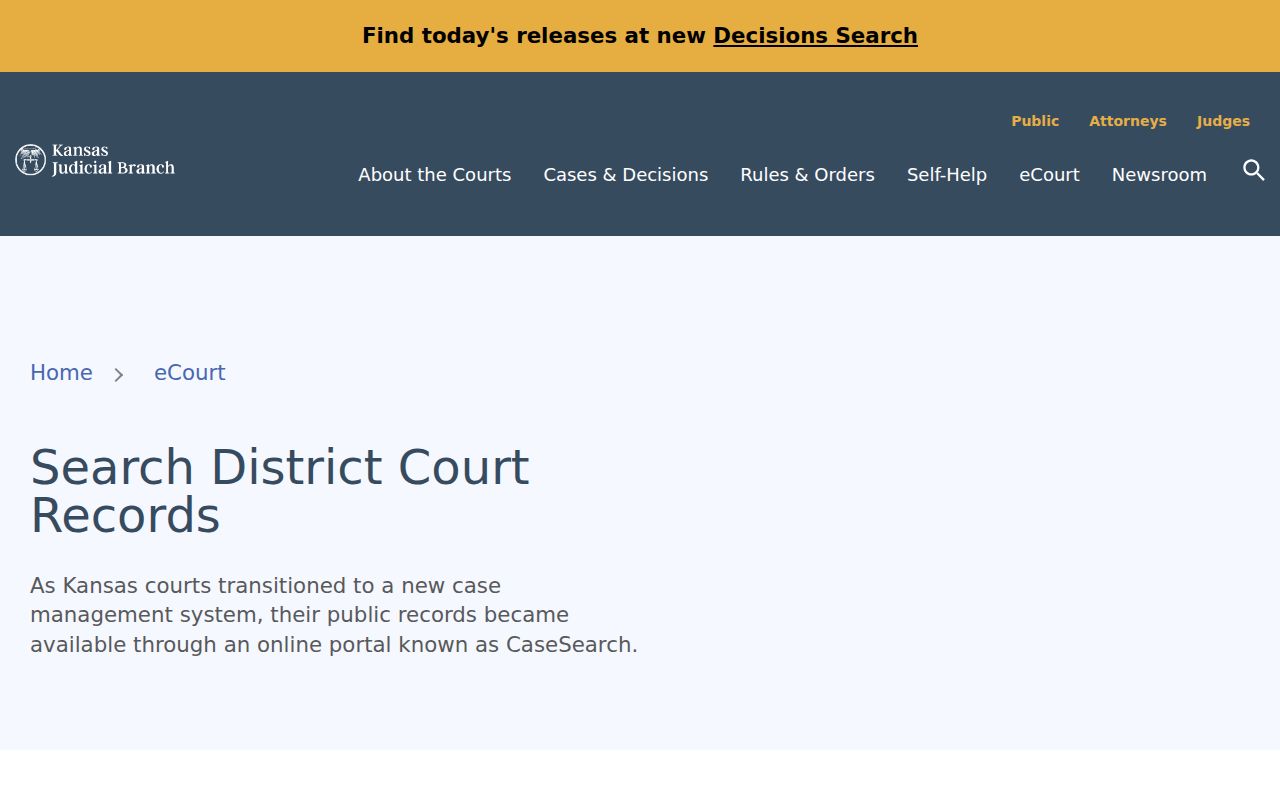
The guidance states the channel distinction in plain terms. When a case is old or a document is missing, jot down the event description and ask the Trego clerk to pull that exact item.
Trego Court Records: What They Contain
A case record blends identifying fields, a time-ordered history, and, when public, the documents behind it. Verify the case number and court before anything else. A similar name alone cannot identify a matter. Remember that an event date marks an entry or filing, which may differ from a hearing date or the day an order took effect.
| Case Number | A Trego identifier such as TR-2026-CV-######, with year and type code. |
|---|---|
| Case Information | Case type, parties, attorneys, judge, filing date, hearings, and public status. |
| Events Index | The chronological docket of filings, actions, settings, orders, and dispositions. |
| Filed Documents | Public petitions, motions, answers, orders, judgments, or exhibits when access permits. |
| Certification | The clerk's authentication of a requested copy, obtained apart from a portal view. |
Use the event list to frame a narrow request. Request the named order or judgment rather than “everything” when one paper will do. That cuts research time and avoids copy charges for material you never needed.
Trego Court Copy Fees
Trego’s court information posts fees for research, plain pages, and faxed pages. The certified-copy fee, exemplification charge, mailing cost, payment method, and turnaround time are not published. So ask for a quote. Say upfront if you need certification. The clerk may have to prepare and seal the copy.
| Service | Published Amount | Request Note |
|---|---|---|
| Records research | $12 per hour | Ask how time is calculated and whether an estimate is needed. |
| Plain copy | $0.50 per page | Confirm the page count before fulfillment. |
| Faxed copies | $2 first page, then $0.50 each | Use the clerk's published request fax. |
| Certified copy | Not published | Ask about certification, seal, postage, and payment. |
Trego County District Court Clerk
216 N Main Street
WaKeeney, KS 67672
Monday-Friday, 8 a.m.-5 p.m.; closed noon-1 p.m.
785-743-2148
Trego Court Filing Is Not Retrieval
Kansas eFlex is the electronic filing system for authorized users, not the public docket viewer. Filed documents then move through court processing, and access rules decide what becomes public. The 23rd Judicial District drop box has the same divide. Its notice serves self-represented parties delivering filings, not anyone searching a docket or requesting records.
Retrieval runs through CaseSearch, the terminal, or the clerk's process. Filing runs through eFlex or clerk filing directions. Mixing the two can delay matters. A records custodian wants a clear description and delivery choice, while a filing desk needs a document meant for the case. The difference matters most when a deadline is close.
Copy Fees and Certification
A plain copy just reproduces the document. A certified copy is different. The clerk authenticates it, and many offices or proceedings will accept nothing less. Before ordering, ask whoever will receive the copy which form they need. Trego County publishes no current certification fee, so treat any online price with doubt.
For a mailed or faxed request, say how you want the copy returned. Ask the clerk how payment must arrive. Keep the request narrow. Vague requests can trigger research time on top of copy costs. Give the case number, the year, the document name, and the event date. That lets the clerk pull the right court record quickly. The KORA form lists pickup and email as delivery choices too. Only the local office can confirm what it sends and whether a filing is public.
Access Rules for Court Records
Public access stops at certain lines. Kansas Supreme Court Rule 24 shields personally identifiable information inside filings. Adoption, juvenile, and child-in-need-of-care matters stay closed. Grand-jury or criminal-investigation material, expunged cases, sealed records, and parts of family or mental-health files do too. Seeing a case listed in the docket does not mean every attachment can be viewed.
Key Kansas rules:
Supreme Court Rule 22 defines portal and courthouse-terminal access.
K.S.A. 45-218 governs inspection, requests, response, and reasonable fees.
K.S.A. 45-221 identifies records that may be withheld under an exception.
If the clerk denies access, ask for the legal basis and whether a public portion can still be released. Do not chase protected data somewhere else. Start with the Trego County docket search to locate the case.
Trego Court Request Precision
Name the layer you want and the clerk's job gets easier. "Case information" covers public identifying fields. An "events index" is the chronological docket itself. A "filed document" points to the petition, motion, order, or judgment behind an entry. "Certified copy" asks the clerk to authenticate the item. Those five phrases spare the clerk from guessing. Guessing is what a vague "case file" invites.
No case number yet? Run the name through CaseSearch or the courthouse terminal first. Then put the confirmed Trego number and the document name into your written request. That step separates a District Court file from a WaKeeney municipal file. It also keeps the request from landing on the county administrative clerk's desk.